Showing posts with label theory. Show all posts

Saturday, September 26, 2020

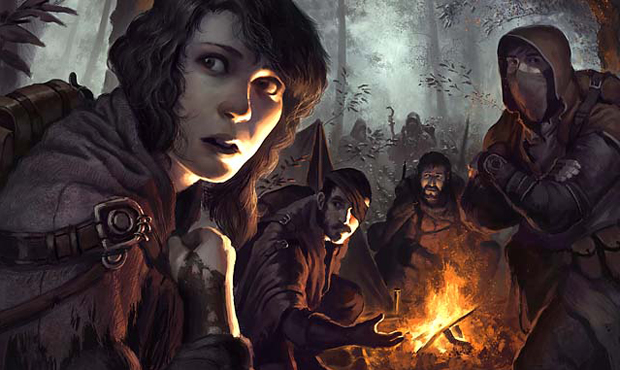
Take Watch is a bad move and you're a bad person if you like it

"Did you hear that? It sounds like... click bait!"

Strong personal opinion: Take Watch is a bad move. You don't need it. Dungeon World doesn't need it. I'd even go so far as to say that it is antithetical to the rest of the game.    

Just to be clear, I'm talking about the bog-standard version in the original Dungeon World text. This one:

When you’re on watch and something approaches the camp roll+Wis. * On a 10+ you’re able to wake the camp and prepare a response, the camp takes +1 forward. * On a 7–9 you react just a moment too late; the camp is awake but hasn’t had time to prepare. You have weapons and armor but little else. * On a miss whatever lurks outside the campfire’s light has the drop on you.

It breaks the usual flow of the game. It doesn't add much of anything to the fiction, and what it does add presumes more than it should about how any given PC will react in every situation. (A full explanation, and what to do instead, after the break.)

Saturday, July 4, 2020

My recipe for starting adventures

I've got a little process that I use whenever I start a game of Dungeon World or Homebrew World. It's similar to the first session procedure that's described in the book, but different in some key ways. I've found that this approach reliably kicks off a new game quickly and with a lot of energy, in a way that makes it pretty darn easy to run and improvise.  

Here's the recipe:
  1. Establish the adventure's premise with the group
      > Premise = a fantastic location + a grabby activity
      > Do this before anyone picks playbooks or makes characters

  2. Players create characters, GM writes/updates hook questions, which should establish:
      > Motive: why are they here, doing this?
      > Stakes: what's on the line, why is this important?
      > Urgency: why shouldn't they dawdle?
      > Dangers: what do they expect to face? what do they know about them?
      > Detail: what specifically are they hunting/seeking/fleeing/fighting/etc.?
      >
    Complications: what's getting in the way? making it harder? constraining them?

  3. Do introductions (by name, pronouns, class, and look).
      > Do not do bonds (or in Homebrew World, background questions) just yet. 
      > You're just establishing who the characters are.
      > Yes, you can ask questions, but keep it light for now.

  4. Ask a few of your hook questions
      > Usually 1-3
      > Pick questions that elaborate on or clarify the premise
      > Address specific PCs, not the group at large
      > Ask follow-up questions; encourage the players to do so, too!

  5. Do bonds (or in Homebrew World, background questions)
      > Ask follow-up questions; encourage the players to do so, too!
      > Use this to establish how they know each other, why they're working together

  6. Finish asking your hook questions
      > Doing bonds/background questions often rolls naturally into this
      > Ask follow-up questions; encourage the players to do so, too!
      > Ask additional questions as they occur to you

  7. Frame the initial scene, tightly
      > Start in media res or at least right on the verge of action
      > Who, where, when, doing what?
      > Give up to 3 strong impressions, ideally from different senses
      > Make a soft GM move
      > "What do you do?"

That's the recipe!  More about the background, details, and suggested prep after the jump break.

I keep hearing good things about Delicious in Dungeon,
but haven't read it; just seemed appropriate, y'know? Cuz recipes.


Saturday, January 11, 2020

My Framework for GMing Dungeon World

I've been working on the GMing chapters for Stonetop, and it's made me think about how the conversation really flows. I've also been thinking about GM moves, and Principles and Agenda, and how they all work together. I thought I'd talk about them a little here. 
I don't think that what follows is fundamentally different than what the game text tells you to do. Like, if you read the DW text and the DW Guide, and GM the game enough, I think you end up doing what I describe below. This is just how I conceptualize it, with 8+ years of experience running, playing, and talking about DW and similar games. (This is also pretty similar to what I describe here.)
Maybe you'll find it useful? Maybe a new GM will find this and something will click for them. Regardless, I'm going to be posting some excerpts from the Stonetop GMing chapters over the next couple weeks, and I think this will help set the stage. 
As always, feedback and questions are appreciated!

The Game is a Conversation

You say something. The players say something. You say something in response. You ask questions of each other, clarify, interrupt, talk over each other. To quote Vincent Baker: "you take turns, but it’s not like taking turns, right?"

The whole point of this conversation is to create the fiction, the shared imaginary space that we're all talking about, where the PCs and NPCs and monsters all exist and act. The game's rules mediate the conversation, and help us figure out what happens when there's uncertainty, and help introduce unexpected and challenging elements into the game.   

Dungeon World is (despite what some folks will tell you) a rather traditional RPG. It structures the conversation and assigns responsibilities and authority in a very familiar way: 
  • The players are responsible for portraying their characters (who they are, their actions, their thoughts and opinions, their experiences and backstory). 
  • The GM is responsible for portraying everything else: the world, the NPCs, the monsters, etc. 
Dungeon World is different than a lot of RPGs because it explicitly encourages (and arguably requires) the GM to ask the players for input on the world, particularly during the first session and about areas where their characters have experience or expertise. But that's not that different than how lots of folks play D&D. (Ever done a session 0 where you make characters, talk about backstory and the kind of setting you want to play in? It's like that, but it's done during play.)

Different groups take this collaborative spirit to different degrees. Some DW GMs are very cognizant of The Line (I know I am) and avoid asking the players to make up details about what their characters are experiencing on the spot. Other GMs will actively ask the players to make up details about the room they've just entered, or the NPC they've just met, or what happens next. Some groups collaborate on where the story should go, and what kinds of scenes they want to have. None of these are wrong. They're just a matter of taste.